The ash
The ash is the fundamental substance of the world in Cormac McCarthy's The Road, a pervasive, gray, and silent residue that blankets everything. It is not merely a detail of setting but the very texture of existence after an unspecified catastrophe, a constant physical presence that defines the sensory and emotional landscape. The ash is the first thing the man encounters each day, blowing in "loose swirls over the blacktop" as he studies the barren valley, and it is the last thing the boy sees, sifting down in the final pages. It is the medium through which the characters move, the taste that never leaves their mouths, and the substance that slowly buries the memory of the world that was.
The Physical Reality of the Ash
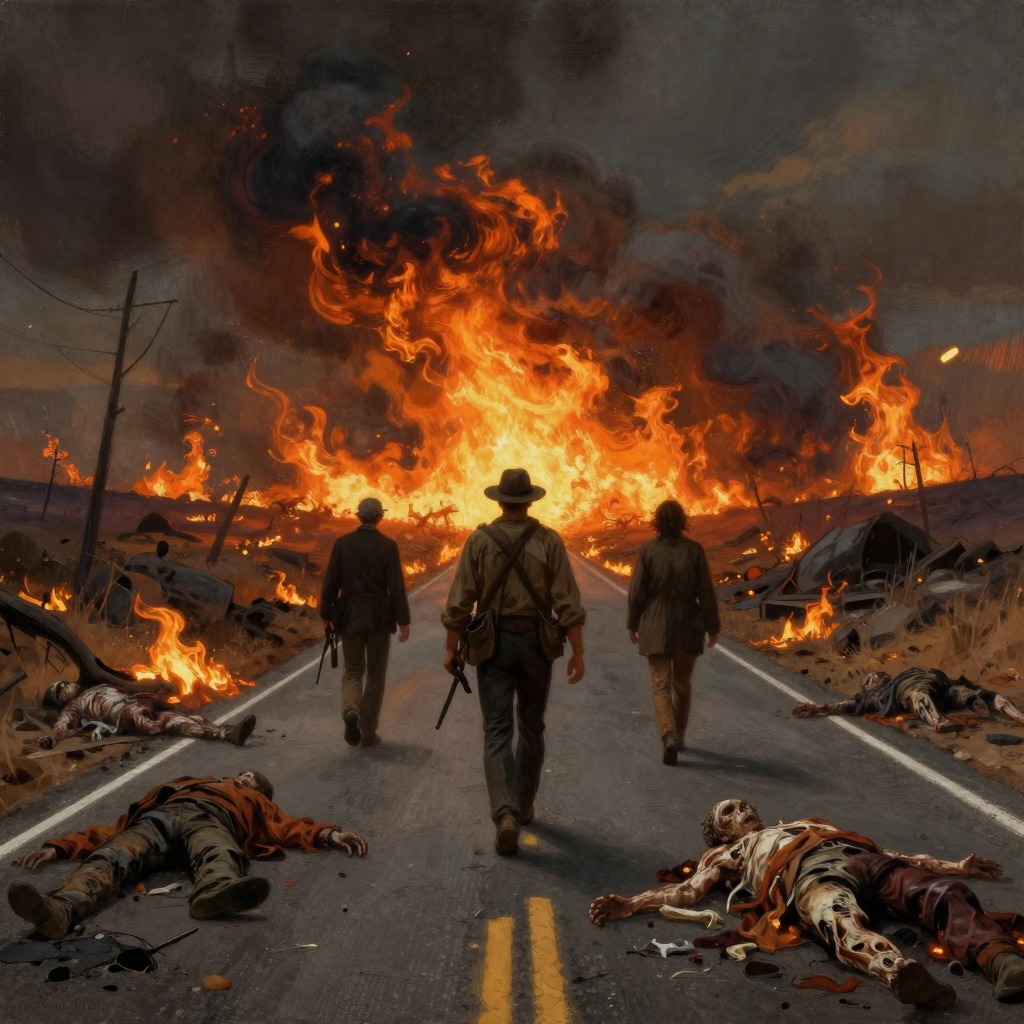
The ash is a tactile, all-encompassing element. It covers the road, the fields, and the cities, turning everything a uniform gray. The man and the boy shuffle through it, their feet leaving tracks that are quickly erased. It is "soft" and "silky," drifting in the wind, and it coats their clothes, their skin, and their food. The ash is so deep in places that it cakes the roadway inches thick, making the cart hard to push. It falls from the sky like snow, and it mixes with rain to form a black slurry. The man wipes his nose on his wrist, and the boy's face is "streaked with black from the rain." The ash is not just on the ground; it is in the air they breathe, a constant irritant that contributes to the man's relentless, bloody cough. It is the physical manifestation of a world reduced to its most inert, mineral state.
The Ash as a Symbol of Erasure and Loss
The ash is the agent of a profound erasure. It covers the familiar contours of the old world, turning houses, billboards, and even the bodies of the dead into anonymous, gray shapes. The man remembers a world of color and life, but the ash has "dimmed away the world" like "the onset of some cold glaucoma." It is the medium through which the past is forgotten. The man's memories, once vivid, turn "to ash instantly" upon waking. The names of things, the colors, the birds—all are slowly "following those things into oblivion." The ash is the physical residue of this process, the "sacred idiom shorn of its referents and so of its reality." It represents the final, silent victory of entropy over meaning.
The Ash and the Condition of the World
The ash is a constant reminder of the catastrophe that has occurred. It is the aftermath of firestorms that have burned everything, leaving "mile on mile of burn" and a "cake of ash in the roadway inches deep." The ash is the evidence of a world that has been consumed. It is also a marker of time and danger. The man and the boy use the ash to read the road, looking for tracks or signs of life. The ash is the surface upon which the story of their journey is written and then erased. It is the "soft black talc" that blows through the streets, and the "silky spills" against the curbing. The ash is the final, indifferent state of all matter, the "bleak and shrouded earth" going "trundling past the sun."
The Ash and the Narrative's Gothic and Ecological Dimensions
The ash creates a landscape of gothic horror, a world of "charred and limbless trunks" and "sagging hands of blind wire." It is the medium through which the dead are revealed, from the "mummied dead everywhere" in the city to the figures "half mired in the blacktop" after the firestorm. The ash is also the central element of the novel's "slow violence," a dispersed, cumulative environmental destruction that is not a single event but a permanent condition. It is the "soft ash moving in the furrows" of a dead field, the "gray coils of viscera" left by the slain, and the "fine black soot" racing along the street. The ash is not just a symbol; it is the toxic, inescapable reality of a world that has been poisoned to its core.
The Ash and the Final Vision
In the novel's closing paragraphs, the ash gives way to a memory of a world before the fall, a world of "brook trout in the streams in the mountains." This vision of life, color, and vitality stands in stark contrast to the gray, ashen world of the narrative. The ash is the "thing which could not be put back," the irreversible loss that defines the entire story. It is the final, silent witness to the end of all things, the "bleak and temporal winds" carrying the "ashes of the late world" to and fro in the void. The ash is the ultimate reality of the novel's world, a world where even the memory of life is slowly being buried.